
Subscribe to get our latest content by email.
Most welding symbol mistakes are not dramatic.
They do not usually involve completely unreadable drawings or obviously incorrect symbols. Instead, they are subtle misinterpretations—small details that are overlooked, assumed, or misunderstood. Over time, these small errors compound into inconsistent welds, unnecessary labor, inspection issues, and rework.
What makes welding symbol interpretation particularly challenging is that many people believe they understand symbols better than they actually do.
This article is part of the Welding Symbols: Where Interpretation Breaks Down series, which examines why welding symbols are frequently misread, misapplied, or misunderstood in real fabrication environments.
One of the most common welding symbol mistakes involves misunderstanding arrow side versus other side requirements.
Many assume:
In reality, the placement of the weld symbol above or below the reference line carries specific meaning. Misinterpreting this distinction can result in welds being placed on the wrong side of the joint—or on both sides when only one was intended.

This mistake often goes unnoticed until inspection or fit-up problems occur.
Weld size is another frequent source of confusion.
Common issues include:
Because fillet welds are so common, many people rely on habit rather than interpretation. This leads to consistent overwelding or, in some cases, undersized welds that fail inspection.
Understanding weld size requires more than recognizing the number—it requires understanding what the number applies to.

Intermittent weld symbols are widely misunderstood, especially in production environments.
Typical errors include:

These mistakes often result in unnecessary weld metal deposition and additional labor—both of which increase cost without improving performance.
Intermittent welds are commonly specified to control distortion, reduce heat input, and manage cost. Misreading them defeats their purpose.
Supplementary symbols—such as all-around, field weld, contour, or finish symbols—are frequently ignored or misapplied.
This happens because:
However, supplementary symbols can significantly affect how a weld is made, finished, or inspected. Ignoring them can create conflict between fabrication and inspection requirements.
 Supplementary welding symbols such as the filed weld (flag) and all-round weld (circle) are easy supplementary weld symbols, yet they are still misread often in a production environments.
Perhaps the most fundamental mistake is treating welding symbols as isolated instructions rather than as part of a larger drawing context.
Welding symbols must be interpreted alongside:
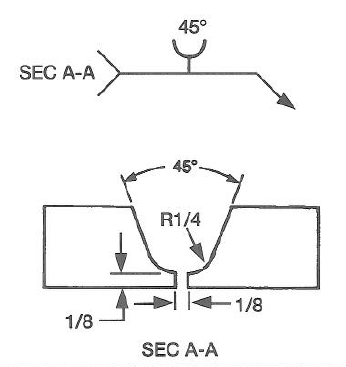
When symbols are read in isolation, assumptions fill in the gaps. This is where interpretation diverges and variability increases.
These interpretation mistakes persist because welding symbols are often learned informally.
Many professionals:
Without structured learning, people tend to apply logic or past experience where precision is required.
Reducing welding symbol mistakes requires a systematic approach, not just better reference materials.
Effective learning typically follows this sequence:
This same sequence applies to video-based learning. The following tutorials are designed to be watched in order:
Each builds on the previous lesson and reinforces the symbol system as a whole.
This article is part of the Welding Symbols: Where Interpretation Breaks Down series.
You can find the full series here:
Welding Symbols: Where Interpretation Breaks Down – Series Hub
If you want to identify where misunderstandings may exist, a free welding symbols test is available and can quickly highlight gaps in interpretation.
For structured, step-by-step learning, the Welding Symbols Training Manual provides detailed explanations, examples, and reference material that support correct interpretation in real fabrication settings.

Learning welding symbols is necessary for many professionals in the welding industry. From welders to welding inspectors, from estimators to quality personnel, knowing this language is an absolute necessity.
The Welding Symbols Training Manual will teach you welding symbols starting from the most basic elements all the way to the very complex symbols. A total of 121 review problems provide plenty of opportunity to test your knowledge as you learn.
You will also get the Welding Symbols Guide which will allow you to interpret welding symbols even before you learn this language. Simply find the type of symbol and use the graphical guide to determine the meaning of all the elements of the symbol at hand.
In addition to the 121 review problems in the Welding Symbols Training manual you also get a comprehensive, 40-question Welding Symbols Test to gauge your proficiency with welding symbols. (Answer keys are provided for both the review problems and the comprehensive test).