

Subscribe to get our latest content by email.
Welding symbols are often described as the universal language of welding.
They are intended to communicate everything required to produce a weld correctly—size, type, location, length, contour, finishing method, and sometimes inspection requirements. When used properly, welding symbols eliminate guesswork and create consistency across design, fabrication, inspection, and estimating.
Yet in practice, welding symbols are widely misunderstood.
Not just by welders—but by engineers, supervisors, inspectors, estimators, and managers who rely on them every day.
This article is part of the Welding Symbols: Where Interpretation Breaks Down series, which examines why welding symbols are frequently misread, misapplied, or ignored in real fabrication environments.
When welding symbols errors occur, the assumption is often that someone “didn’t know how to read the symbol.”
In reality, most problems stem from systemic gaps in training and expectation, not from a lack of intelligence or effort.
Many professionals:
This leads to partial understanding—which is often more dangerous than none at all.
One of the most common reasons welding symbols are misunderstood is that they are treated as individual symbols, rather than as a structured system.
A welding symbol is not just:
It is a complete instruction set, made up of:
Misinterpreting any one of these elements can change the meaning of the entire instruction.
In many shops, people are exposed to welding symbols only when a problem arises.
A print shows up.
A symbol looks unfamiliar.
Someone searches online for a quick answer.
This reactive approach creates two problems:
Without understanding the basics, reference charts and cheat sheets may become confusing instead of helpful.
Fillet welds account for the majority of welds in general fabrication.
Ironically, they are also one of the most frequently misunderstood symbols.
Common issues include:
Because fillet weld symbols appear “simple,” they are often assumed to be understood—when they are not. Making the assumption that welders will figure it out if symbols come up in drawings is one of the most costly mistakes owners and managers of fabrication companies make.
This is one reason overwelding and inconsistent weld sizes are so common.
Misunderstood welding symbols do not just affect weld appearance.
They impact:
When symbols are unclear—or misunderstood—decisions are pushed to the shop floor, where variability increases.
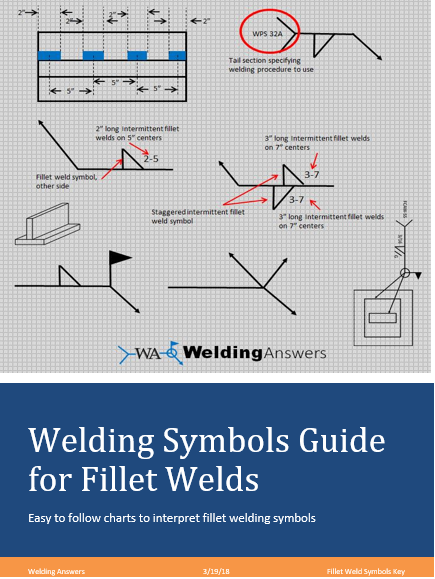
Many professionals rely on welding symbol charts as their primary learning tool.
Charts are useful—but only after the foundational rules are understood.
Without that foundation:
Training that explains why symbols are structured the way they are is far more effective than memorizing symbol shapes.
Effective welding symbol training follows a sequence:
This same sequence applies to visual learning.
For those who prefer video-based instruction, these tutorials are designed to be watched in order:
Each builds on the previous one and mirrors how welding symbols are actually used in practice.
This article is part of the Welding Symbols: Where Interpretation Breaks Down series.
You can find the full series here:
Welding Symbols Series Hub
If you want to evaluate your current understanding of welding symbols, a free welding symbols test is available and can quickly highlight knowledge gaps before they become production issues.
For those looking for structured, step-by-step training, the Welding Symbols Training Manual was developed as a practical learning and reference tool, covering symbols from basic fillet welds through complex multi-reference-line callouts.

Learning welding symbols is necessary for many professionals in the welding industry. From welders to welding inspectors, from estimators to quality personnel, knowing this language is an absolute necessity.
The Welding Symbols Training Manual will teach you welding symbols starting from the most basic elements all the way to the very complex symbols. A total of 121 review problems provide plenty of opportunity to test your knowledge as you learn.
You will also get the Welding Symbols Guide which will allow you to interpret welding symbols even before you learn this language. Simply find the type of symbol and use the graphical guide to determine the meaning of all the elements of the symbol at hand.
In addition to the 121 review problems in the Welding Symbols Training manual you also get a comprehensive, 40-question Welding Symbols Test to gauge your proficiency with welding symbols. (Answer keys are provided for both the review problems and the comprehensive test).