
Protecting Your Eyes from the Welding Arc: Welding Shade Numbers and Safety Glasses
Have you ever had your eyes burned by the welding arc rays? Was it because you didn’t wear safety glasses at work? Or did you weld without a welding helmet? Regardless of the reason, if you got an arc burn you better be ready for a very unpleasant night. If you burn your eyes at […]
The Importance of Accurate Documents to Support Welder Qualifications
When it comes to precision welding and fabrication, it only takes one wrong document to cause a major problem. Still, many companies operate by the motto: “if it ain’t broke, don’t fix it”. Assuming you have incredible attention to detail and a lot of luck, that approach might work for a while. That’s why companies […]
How to Keep Welder Qualifications Active
There is a misconception that welder qualifications are only good for six months. This is not accurate. Most codes state that welder qualifications may lapse if the welder is not engaged in a given process for which he or she is qualified for a period exceeding six months. This means that as long as the […]
How to Avoid Sensitization When Welding Austenitic Stainless Steels
Stainless steels are iron based alloys that contain a minimum of 10.5% chromium. This chromium reacts with the air and forms a very thin but very tenacious chromium oxide layer which is what prevents stainless from rusting. There are 5 types of stainless steels which are categorized depending on additional alloying elements. One thing they […]
Modes of Metal Transfer: Pulse
Pulsed spray refers to a GMAW mode of transfer in which metal droplets are transferred through the arc with changes in amperage produced by the power source. The power source provides a pulsing peak current that raises the amperage above the transition current and allows for axial spray transfer. This peak current is only applied […]
Modes of Metal Transfer: Spray
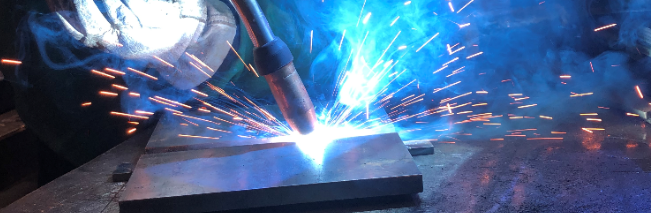
Spray is a mode of metal transfer in which a fine spray of metal droplets are projected axially from the tip of the electrode to the work. These droplets are smaller in diameter than the electrode. This mode of transfer is characterized by high wire feed speeds (high amperage), high voltage and consequently high heat […]
Modes of Metal Transfer: Globular
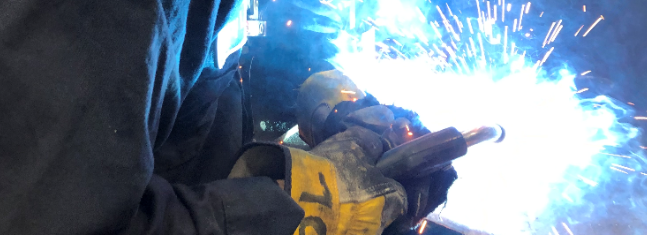
In our last post we explained short circuit transfer; if you missed it you can go back and read Modes of Metal Transfer: Short Circuit. In this post we’ll spend some time going over globular transfer by covering its basics as well as its advantages and limitations. Globular transfer occurs in GMAW and MCAW processes […]
Modes of Metal Transfer: Short Circuit
The modes of metal transfer refer to the different ways in which the filler metal (electrode) is transferred through the welding arc and into the weld puddle. We can write a book on this topic but we’ll keep it simple to provide an understanding of the different modes of transfer, what they require and what […]
Who Is Required To Know Welding Symbols?
Knowledge of welding symbols is not a requirement limited to welders. Many other professionals must have the ability to interpret and write welding symbols. From estimators to designers to quality personnel, this universal language must be understood. In our last post we touched briefly on the importance of being able to interpret welding symbols. If […]
Can You Read Welding Symbols?
Welding symbols are the universal language of the welding industry. They are used to communicate vital information regarding the details of a weld including: Joint details Weld size and length Weld sequence Contour finish Location Process Required inspection methods Penetration requirements Etc. Yet this important language is not understood by the vast majority of those […]