
Subscribe to get our latest content by email.
If you need to calculate weld metal requirements and you do not have The Procedure Handbook of Arc Welding
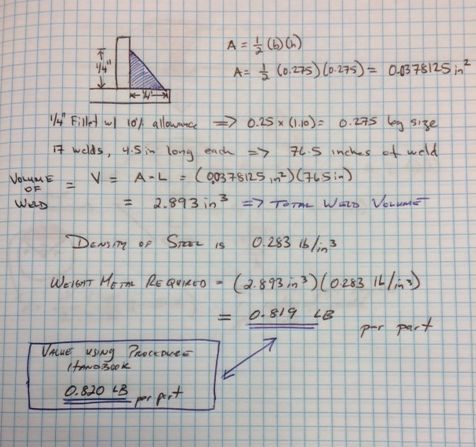
2.89 cubic inches x 0.283 pounds/cubic inch = 0.819 pounds per part. We compare this to the values obtained from using Table 12.1 in the Procedure Handbook and we are dead on.
Doing this for fillet welds is easy. Once you throw a more complicated joint like a double-V butt weld it gets a bit harder. Look at the difference on our notebook below:
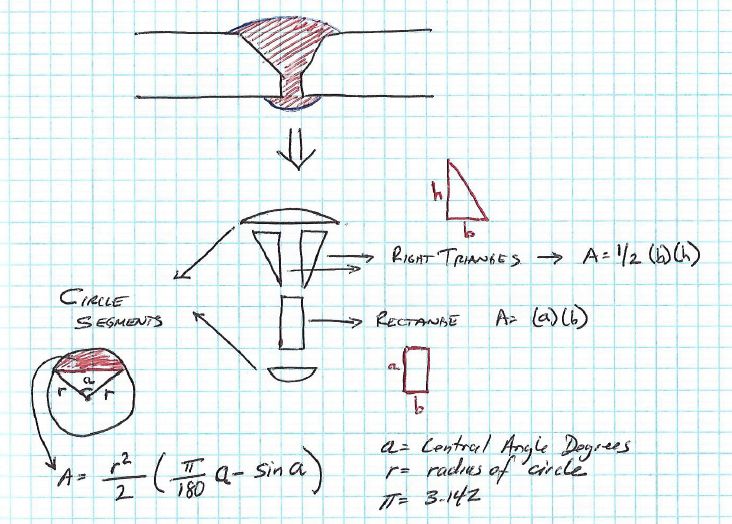
Instead of a simple triangle, we know take the cross section of the joint and divided into shapes for which we can calculate the area. In the notes above we see that we end up with 2 triangles, 2 circle segments, and 1 rectangle. For this type of joint, table 12-1 of the Procedure Handbook has what you need. However, when you start dealing with J-grooves and other complicated groove joints you may need to do it by hand. There are tables for these joints as well but it seems they are published in obscure books and technical reports.