Welding Guide Subscription Form
Welding Guide

Get your FREE guide on what every welding engineer must know

Subscribe to get our latest content by email.

We won't send you spam. Unsubscribe at any time.
The Hidden Assumptions Built Into Most Welding Procedures
Most welding procedures are created with good intentions.They are based on prior experience, established practices, and an understanding of code requirements. On the surface, they appear reasonable and complete. Yet once production begins, unexpected problems emerge—often repeatedly and without an obvious cause.In many cases, these problems are not the result of incorrect variables or poor workmanship. They stem from assumptions that were never identified, challenged, or validated during procedure development.This article is part of the Developing Welding Procedures in the Real World series, which examines how welding procedures are developed, implemented, and used in real fabrication environments.

Every Welding Procedure Is Built on Assumptions

A Welding Procedure Specification (WPS) cannot capture every detail of a fabrication environment. As a result, every procedure—no matter how well developed—relies on assumptions.These assumptions may relate to:
  • Base material condition
  • Joint fit-up and consistency
  • Welding position and access
  • Welder skill and technique
  • Equipment capability and maintenance
  • Environmental conditions
The problem is not that assumptions exist. The problem is that many of them are never consciously acknowledged.When assumptions go unexamined, the procedure may only function under ideal conditions—and fail as soon as reality deviates.
A prequalified WPS may be properly developed and written, but if the parameters are not adeqaute for out of position welding the welder will need to make adjustments - many times taking him/her out of the qualified range for certain essential varibles such as amperage and voltage.
A qualified or prequalified WPS may be properly developed and written, but if the parameters are not adeqaute for out of position welding the welder will need to make adjustments – many times taking him/her out of the qualified range for certain essential varibles such as amperage and voltage.

Assumptions About Base Materials

One of the most common hidden assumptions is that base materials behave consistently.Materials may meet the same specification yet differ significantly in:
  • Chemistry
  • Thickness tolerance
  • Surface condition
  • Supplied heat treatment or forming history
When these differences are not considered during procedure development, weldability issues such as cracking, lack of fusion, or inconsistent penetration can appear unexpectedly.The procedure itself may remain unchanged, while the root cause goes unnoticed. 

Assumptions About Joint Fit-Up and Fabrication

Welding procedures are often developed assuming ideal joint conditions.In practice, joints vary due to:
  • Fit-up tolerances
  • Distortion from prior operations
  • Variability in cutting or forming processes
A procedure that works well under controlled conditions may become difficult to follow when fit-up deviates from what was assumed. Welders compensate informally, and variability increases.The WPS still exists—but it no longer governs the process. 

Assumptions About Welder Skill and Consistency

Another frequent assumption is that welders will naturally adapt to the procedure.In reality, welders bring different levels of experience, technique, and comfort with specific processes. A procedure that relies on fine parameter control or narrow operating windows may only be usable by a subset of the workforce.When this assumption is not addressed during development, production performance becomes operator-dependent rather than procedure-driven. 

Assumptions About Equipment and Environment

Procedures are also developed with implicit expectations about equipment and conditions.These include assumptions about:
  • Power source capability and stability
  • Wire feeding consistency
  • Torch access and ergonomics
  • Ambient temperature, wind, or cleanliness
When actual conditions differ from what was assumed, weld quality and productivity suffer—even though the procedure itself has not changed.
Assuming that outdoor conditions are favorable can be a mistake. A welding procedure that requires no preheat during warmer months may not be adequat for welding when the ambient temperature dips below 32F.

Why These Assumptions Rarely Get Challenged

Hidden assumptions persist because procedures are often developed under time pressure or based on prior success.If a similar procedure worked before, it is assumed to be suitable again. If the variables fall within code limits, further scrutiny feels unnecessary.This reactive approach shifts problem-solving to production, where changes are harder, more expensive, and less controlled. 

How Hidden Assumptions Undermine Engineering Intent

Engineering intent, as discussed in the previous article (How Engineering Intent Gets Lost Between the Welding Procedure and the Shop Floor) is embedded in the structure of the procedure.When assumptions are left unexamined:
  • Variable ranges become overly broad
  • Limitations are not clearly defined
  • Procedures invite interpretation rather than control
As a result, intent is diluted—even if the procedure is technically correct. 

What Welding Engineers Do Differently

Welding engineers approach procedure development with the expectation that assumptions exist.Rather than ignoring them, they:
  • Identify critical assumptions explicitly
  • Evaluate whether those assumptions hold in production
  • Adjust procedures to reflect actual conditions
  • Validate decisions before full-scale production
This does not eliminate variability, but it reduces surprises and improves repeatability. 

Practical Takeaways

  • Every welding procedure relies on assumptions
  • Unexamined assumptions are a major source of failure
  • Many production problems originate from idealized expectations
  • Effective procedure development anticipates real-world variability
 

Series Context

This article is part of the Developing Welding Procedures in the Real World series, which examines how welding procedures are developed, implemented, and used in real fabrication environments. 

Additional Context

Identifying and validating assumptions is a critical part of developing usable welding procedures. When assumptions are left unchallenged, procedures may comply with codes yet fail in production.The structured approach discussed throughout this series emphasizes evaluating these assumptions early—before welding begins—so that procedures reflect how work is actually performed.
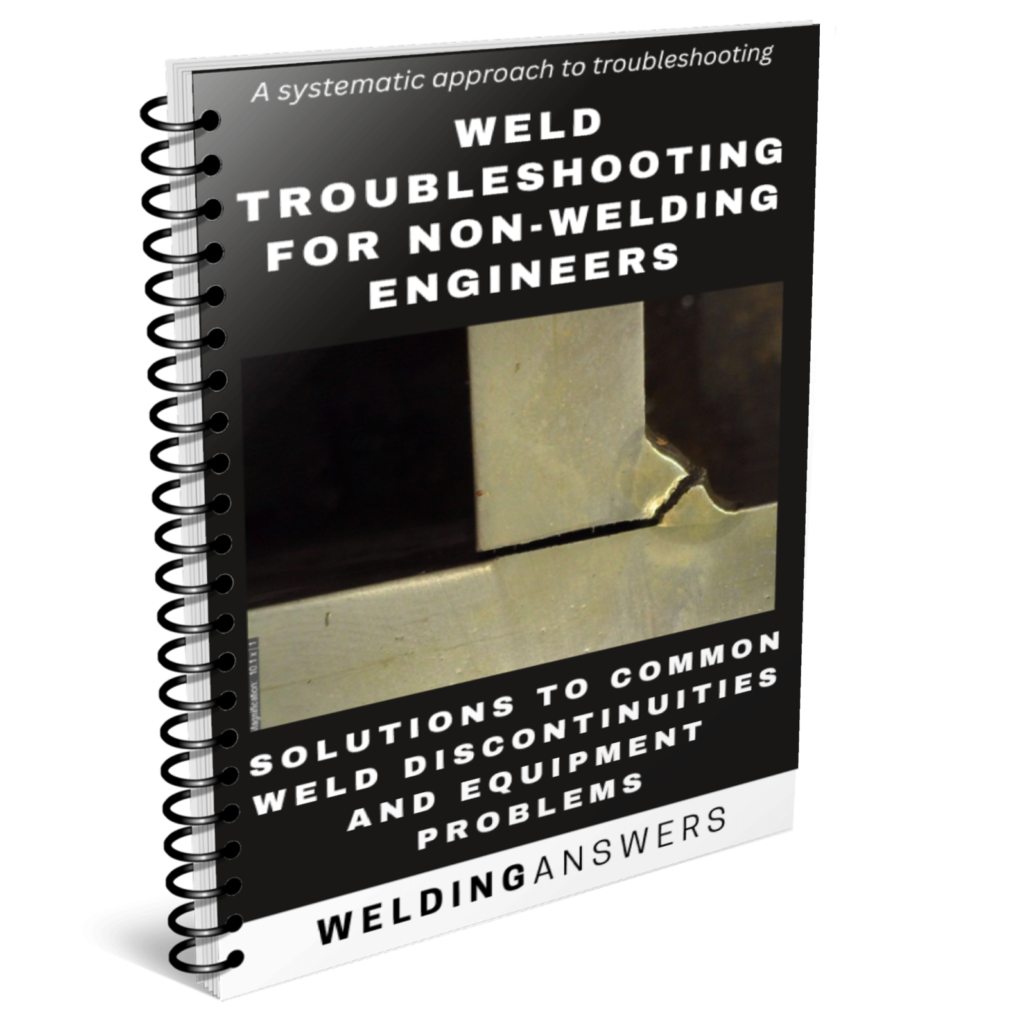
 Weld Troubleshooting for Non-Welding Engineers
Learn and follow the process used by welding engineers to find the root cause of welding problems and their solutions. This troubleshooting guide goes beyond your typical troubleshooting charts on the back of an owner’s manual. The goal is not just to help you solve a welding problem, but to teach the concepts and theory behind it. Understanding why a recommended solution worked is just as important as solving the problem. This guide addresses the most common weld discontinuities and defects as well as the most common welding equipment problems.
Facebook
Twitter
LinkedIn
WhatsApp
Email
Telegram