Subscribe to get our latest content by email.
Welding engineers are often faced with a practical decision early in a project:
Should a welding procedure be developed from scratch, or should a prequalified welding procedure be used?
In many cases, this question is framed incorrectly—as if one option represents engineering rigor and the other represents compromise. In reality, prequalified welding procedures can be one of the most effective tools available to welding engineers when they are used intentionally and within the limits established by the governing code.
This article is part of the Developing Welding Procedures in the Real World series, which examines how welding procedures are developed, implemented, and used in real fabrication environments.
Prequalified welding procedures are permitted by many welding codes because they are based on long-standing industry knowledge and proven combinations of variables.
When used appropriately, they offer clear advantages:
From an engineering standpoint, prequalified procedures are not shortcuts. They are recognized, validated starting points.
Ignoring them when they are permitted often adds cost and complexity without adding value.
One of the most common misunderstandings about prequalified welding procedures is the assumption that they eliminate the need for engineering judgment.
They do not.
Prequalification establishes which combinations of variables are allowed without qualification testing. It does not determine whether those combinations are:
A prequalified procedure still must be developed, not merely adopted.
This is where the principles discussed throughout this series apply directly.
Welding engineers who use prequalified procedures effectively treat them as a foundation rather than a finished product.
They evaluate whether the prequalified variables:
When these factors are considered, a prequalified welding procedure can move into production quickly and reliably.
When they are ignored, the procedure may remain technically compliant while failing operationally.
There are situations where prequalified welding procedures are not suitable.
These include cases where:
In these cases, welding engineers are not abandoning prequalification—they are recognizing its boundaries.
When prequalified procedures cannot accommodate real-world conditions, the correct response is not to force their use, but to revise the procedure and qualify it through testing in accordance with the governing code or standard.
Qualification testing should not be viewed as a failure of prequalification.
It is a continuation of the same engineering process.
By the time a welding engineer decides to qualify a procedure:
The resulting qualified welding procedure is stronger because it is based on deliberate development rather than trial-and-error.
Throughout this series, the focus has been on:
Prequalified welding procedures fit squarely within this framework.
They are not alternatives to good engineering practice.
They are tools that support it, when used correctly.
This article is part of the Developing Welding Procedures in the Real World series, which examines how welding procedures are developed, implemented, and used in real fabrication environments.
You can find the full series and related articles here:
Developing Welding Procedures in the Real World
Prequalified welding procedures reflect decades of industry experience and are intentionally included in welding codes to streamline development where risk is already well understood.
When welding engineers apply the same discipline discussed throughout this series—evaluating assumptions, usability, and production realities—prequalified procedures can be deployed efficiently and confidently.
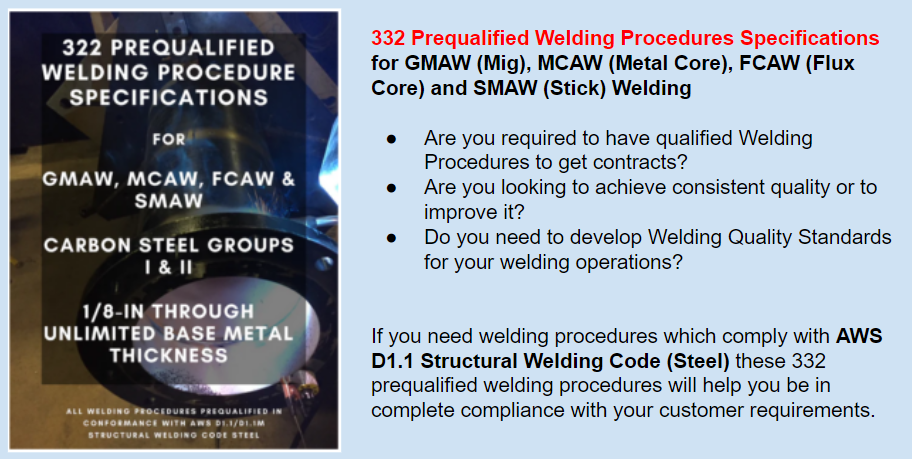
For situations where prequalified welding procedures are permitted and appropriate, having properly developed and documented procedures available can significantly reduce engineering effort and accelerate production.
Collections of AWS D1.1 Prequalified Welding Procedures and AWS D1.6 Prequalified Welding Procedures provide a structured starting point that can be adapted, reviewed, and implemented with engineering oversight rather than created from scratch each time.