Subscribe to get our latest content by email.
Competition among welding equipment manufacturers is a great thing. Companies such as Miller, Fronius, OTC, Lincoln Electric, and others continue to develop welding machines that are more capable, easier to use, and increasingly affordable.
Welders and manufacturers have benefited tremendously from these advancements.
However, there is a potential downside: the belief that better welding equipment is the answer to almost every welding problem.
There is certainly nothing wrong with buying new welding equipment. We like new welding machines as much as anyone. Pulsed MIG welding, advanced waveforms, and modern synergic controls can provide significant advantages.
But before spending your hard-earned money on the latest welding power source, ask one important question:
Have you exhausted the capabilities of the equipment you already have?
Before deciding that new welding equipment is necessary, determine what is actually causing the problem.
You need to identify the root cause before taking corrective action. Following a strucgtured failure analysis is always recommended.
Buying new welding equipment to address symptoms such as excessive spatter, distortion, burn-through, or lack of penetration without first understanding the cause is similar to treating an unknown infection with a broad-spectrum antibiotic. It might work, but you are treating the symptom before fully understanding the problem.
Start with the welding procedure.
You may be surprised by how many welding problems can be corrected through changes to welding parameters, technique, process selection, or weld size rather than by purchasing new equipment.
Pulsed MIG welding can absolutely provide benefits. But let’s look at several common welding problems and consider what can be done when conventional CV welding equipment is already available.
One of the most commonly cited advantages of pulsed MIG welding is reduced spatter.
Pulse provides controlled metal transfer and can produce a very smooth arc with minimal spatter when properly set. However, conventional GMAW can also produce very low levels of spatter when the welding procedure and equipment are properly set up.
If your current welding procedure is producing excessive spatter, investigate the cause before replacing the machine.
Common causes can include:

Problems such as damaged welding cables or dirty or clogged gun consumables can also contribute to poor arc performance.
For a more detailed discussion, see 7 Causes of Spatter and How to Eliminate It.
Pulse welding is frequently used to help reduce distortion because it can reduce overall heat input.
That advantage is real.
However, before changing welding processes, look at the weld itself.
Is the weld larger than necessary?
Check the drawing or weld specification. If the weld is larger than required, reducing the weld to the specified size may significantly reduce distortion. Larger welds require more weld metal and create greater shrinkage as the weld cools.
If the weld is already the proper size, look at the welding procedure.
Heat input can often be reduced by increasing deposition rate and increasing travel speed rather than simply reducing amperage and welding more slowly.
This sometimes goes against conventional thinking, but travel speed has a major effect on welding heat input.
See How to Calculate Heat Input From Welding for a better understanding of the relationship between amperage, voltage, travel speed, and total heat input.
Burn-through is commonly associated with excessive heat or poor joint fit-up.
Pulse welding can help because it provides greater control over heat input and the weld puddle. However, conventional equipment may still provide options.
Reducing welding current may help when excessive heat is the problem. When welding thin material or bridging gaps, short-circuit transfer may also be an appropriate option.
The important point is to understand why burn-through is occurring before assuming that new welding equipment is required.
This is one area where pulsed MIG welding can provide a significant advantage.
When welding vertical-up or overhead with solid wire, pulse allows the weld puddle to solidify more rapidly between pulses. This improves puddle control and can allow higher wire feed speeds than conventional solid-wire procedures in these positions.
But pulse is not the only option.
Flux-cored arc welding can also provide very high deposition rates when welding out of position. The slag system helps support the molten weld puddle, allowing higher wire feed speeds while maintaining control of the weld pool.
For example, an E71T-1 .045-inch flux-cored wire running at 425 inches per minute can produce a deposition rate of approximately 8.5 pounds per hour when welding overhead.
For operations limited to conventional equipment, changing the welding process may therefore provide another path to higher productivity.
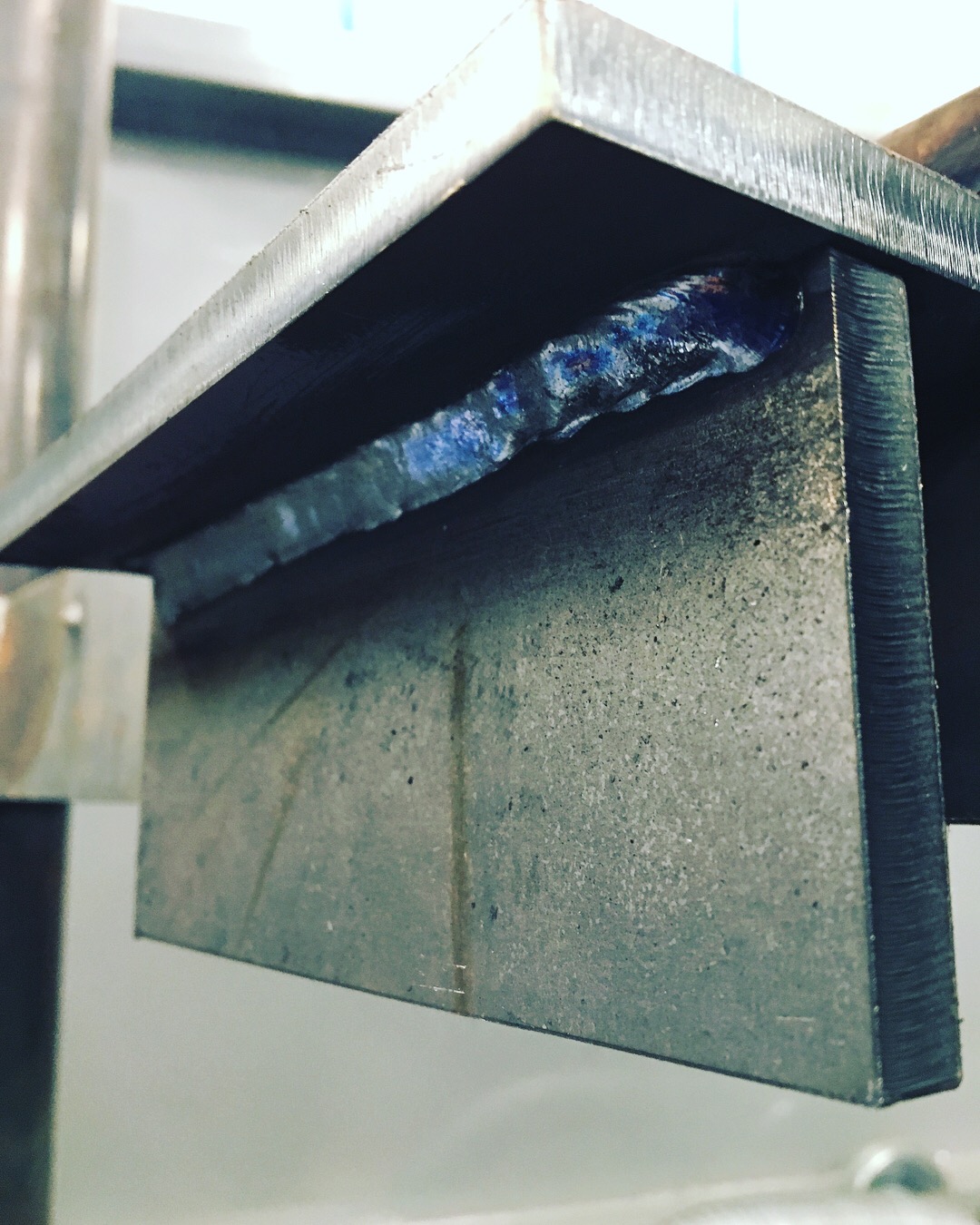
As discussed in the distortion section, reducing heat input does not necessarily require pulse welding.
Start by making sure the weld is no larger than required.
Then examine welding parameters and travel speed.
In many applications, increasing deposition rate and traveling faster can reduce the amount of heat introduced per unit length of weld.
Selecting the right welding parameters is essential.
Pulse welding can provide excellent penetration and fusion characteristics while maintaining control over average heat input.
However, lack of penetration does not automatically mean pulse welding is required.
If penetration is inadequate with an existing welding procedure, evaluate the welding parameters first. Increasing welding current can increase penetration when the other welding variables are appropriately controlled.
The important step is identifying why penetration is inadequate before changing equipment.
A properly developed conventional GMAW procedure may be capable of providing the required penetration without purchasing a different welding machine.
Modern pulsed MIG systems can make welding easier.
Advanced controls can provide a more forgiving operating window, improve puddle control, and simplify parameter selection.
But technology should not replace welder training.
Welders still need to understand proper gun angle, travel speed, contact-tip-to-work distance, joint configuration, weld size, and parameter selection.
Advanced equipment is most effective when the person using it understands the fundamentals of welding.
None of this is intended to discourage anyone from purchasing pulsed MIG welding equipment.
Pulse welding is an extremely useful technology and can provide major advantages in the right applications.
But it should not automatically be the first answer to every welding problem.
Excessive spatter, distortion, burn-through, high heat input, poor penetration, and low deposition rates may often be improved through better welding procedures, parameter selection, technique, or process selection.
Before investing in new equipment, understand the problem.
Determine the root cause.
Optimize the welding process you already have.
Then, if pulsed MIG welding provides an advantage that your existing equipment cannot deliver, you can make the investment knowing exactly why you need it.
That is a much better reason to buy a welding machine than simply hoping new technology will solve an old welding problem.
References:
Welding Procedure Development for Non-Welding Engineers (2021)
Metals and How to Weld Them – Theodore Jefferson, Gorham Woods
Welding Metallurgy and Weldability by John C. Lippold
Are you tasked with developing, qualifying and approving welding procedures? Are you in need for procedures that adhere to AWS D1.1 Structural Welding Code – Steel? If so, the use of prequalified Welding Procedure Specifications will help you save time and money. It will also help with quality and consistency. Qualification testing for a single welding procedure can cost over $1,000 depending on the necessary tests. Prequalified WPSs are exempt from testing and ready to use.