Subscribe to get our latest content by email.
Most weld troubleshooting efforts fail for a simple reason: they focus on fixing the current weld, not the system that produced it.
When a defect appears, the pressure is to act quickly. Welding parameters are adjusted, techniques are changed, consumables are swapped, and production moves on. Sometimes the problem disappears. More often, it returns later—on a different joint, a different shift, or a different job.
This cycle continues because troubleshooting is treated as a reaction, not a process.
Effective weld troubleshooting is not about finding a quick fix. It is about applying a repeatable framework that identifies root causes, validates corrective actions, and prevents the same problems from resurfacing.
This article is part of the Practical Weld Troubleshooting in Production series, which focuses on diagnosing and correcting weld problems using systematic, engineering-based methods rather than trial and error.
Across fabrication environments, failed troubleshooting efforts tend to share common characteristics:
When this happens, troubleshooting becomes anecdotal. Knowledge stays with individuals instead of becoming part of the organization.
A framework is what turns troubleshooting from a one-time reaction into a repeatable capability.
The first step in effective troubleshooting is defining the problem precisely.
Vague descriptions such as “bad welds” or “quality issues” are not actionable. Instead, the problem should be described in terms of:
A clearly defined problem narrows the field of possible causes and prevents unnecessary changes.
Before any corrective action is taken, information must be gathered.
This includes:
This step is often skipped under time pressure, yet it provides the evidence needed to troubleshoot effectively.
Once information is gathered, potential causes can be evaluated logically.
Instead of asking:
“What usually causes this problem?”
A more productive question is:
“What conditions must exist for this defect to occur?”
This shift moves troubleshooting from opinion to a true failure analysis.
One of the most common reasons troubleshooting fails is that too many changes are made at once.
When multiple variables are adjusted simultaneously:
Effective troubleshooting requires making one change at a time, observing the result, and documenting the outcome.
A defect disappearing once does not mean it has been eliminated.
Verification requires:
Without verification, temporary improvements are often mistaken for permanent solutions.
Once a solution is verified, it must be embedded into the system.
This may include:
If the solution is not standardized, the problem will eventually return.
The final—and most overlooked—step is documentation.
When troubleshooting efforts are not documented:
Documenting what caused the problem, what fixed it, and why it worked transforms troubleshooting into a long-term asset.
The same framework applies whether you are troubleshooting:
The specific causes change, but the process does not.
This is what allows welding engineers to solve problems consistently across different materials, processes, and applications.
Individual fixes solve individual problems.
A framework builds organizational capability.
Shops that rely on a structured troubleshooting approach:
This is what separates reactive operations from stable, high-performing ones.
This article is part of the Practical Weld Troubleshooting in Production series.
You can find the full series here:
Practical Weld Troubleshooting in Production – Series Hub
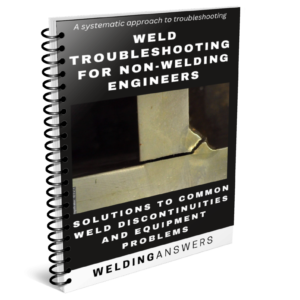
The framework outlined in this article is expanded and applied across a wide range of weld defects in Weld Troubleshooting for Non Welding Engineers.
The guide provides a structured approach for diagnosing and resolving recurring weld problems, making it a practical reference for engineers, inspectors, supervisors, and managers responsible for weld quality in production environments.
For more information CLICK HERE or the image below.